Prove roadmap ROI

Prove roadmap ROI with customer evidence

Prove roadmap ROI with the customers, distinct accounts, and revenue behind every request, an internal roadmap with the evidence attached, and a record of what shipped.
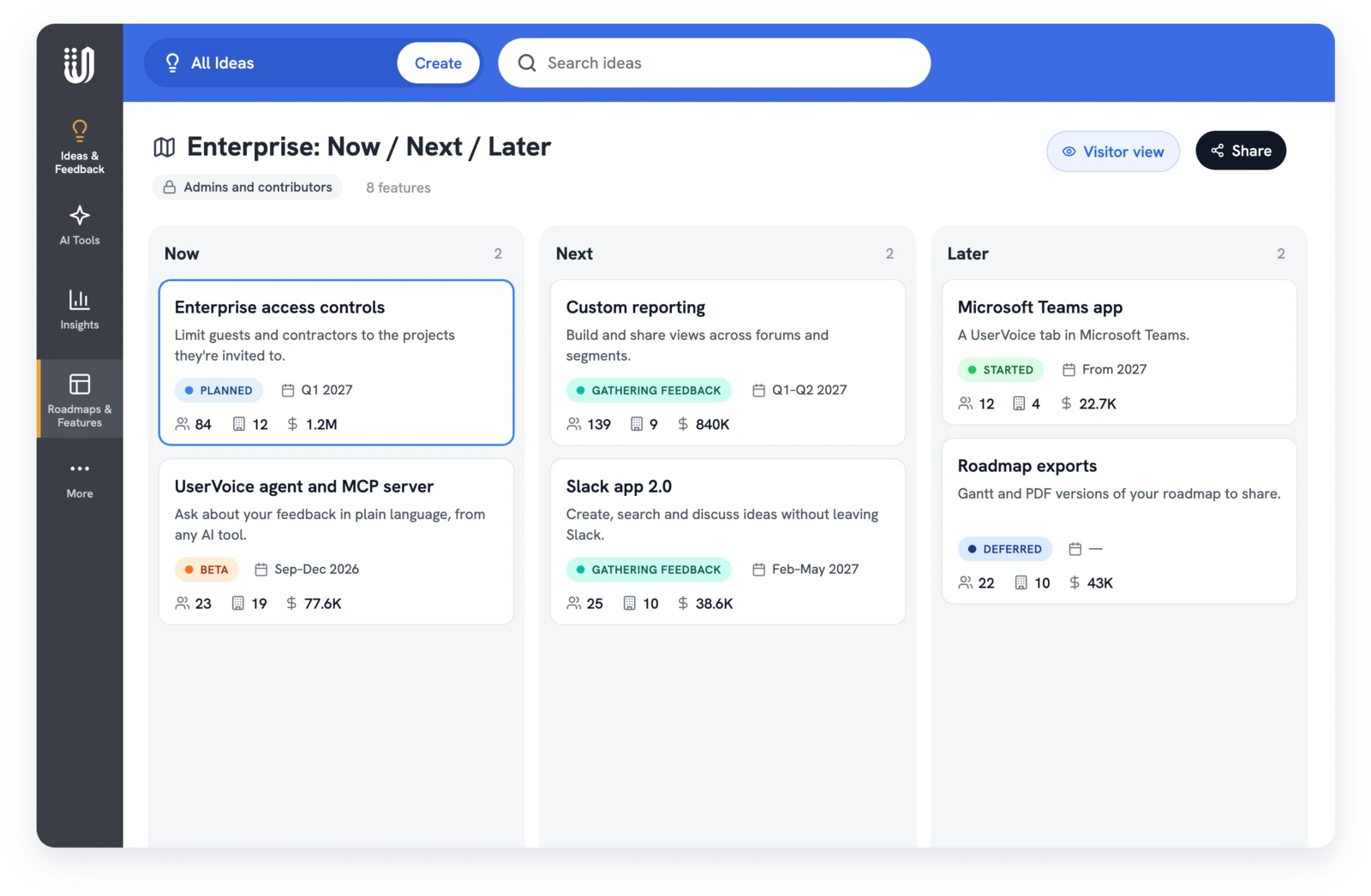
UserVoice internal Now, Next, Later roadmap beside the public roadmap customers see

What users say on G2

Read all 240+ reviews on G2
A huge input into deciding what our roadmap will look like.
Josue T.
Mid-Market (51-1,000 employees), verified review on G2
Implementing enhancements that are driven by the highest votes on customer-generated ideas.
Dan T.
Director, Customer Experience Systems, Enterprise, verified review on G2
What you can show

The roadmap ROI evidence leadership asks for

Leadership asks why work made the roadmap and what it was worth, and most teams answer with vote counts and anecdotes. UserVoice gives you the customer side of the business case: every question below has an answer in the product.

Question leadership asks
Evidence in UserVoice
Where to find it
Who asked for this?
The customers and their words on the idea
The idea sheet's supporters and activity
How much of the business is asking?
Distinct accounts and their combined revenue
Revenue and Accounts columns in the idea grid
Is the demand broad or concentrated?
Accounts compared with votes, by segment
Account Insights, filtered by segment
What's on the roadmap and why?
Roadmap cards with revenue, accounts, and users
The internal roadmap, shared with leadership
Did we follow through?
Statuses Updated, Voters Impacted, Accounts Affected, and Revenue Addressed
The Activity Report
What did deals say?
Potential and lost opportunity revenue
Opportunity columns from Salesforce
Outcomes

Decisions you can defend in any review

What changes when every roadmap item carries its customers.
Decisions you can defend
Each item shows the accounts, revenue, and words behind it, so the review starts from facts.
Fewer pet projects
Ideas with broad support and high revenue rise on their own, so the loudest stakeholder doesn't set the plan.
A record of follow-through
The Activity Report shows which statuses moved and how many voters, accounts, and dollars they reached.
Customer evidence

Start with what customers are trying to do

Every idea collects the customers who asked, their words, and the accounts they belong to. Feedback keeps a source link back to the ticket, email, or call it came from, so anyone can check the original request.
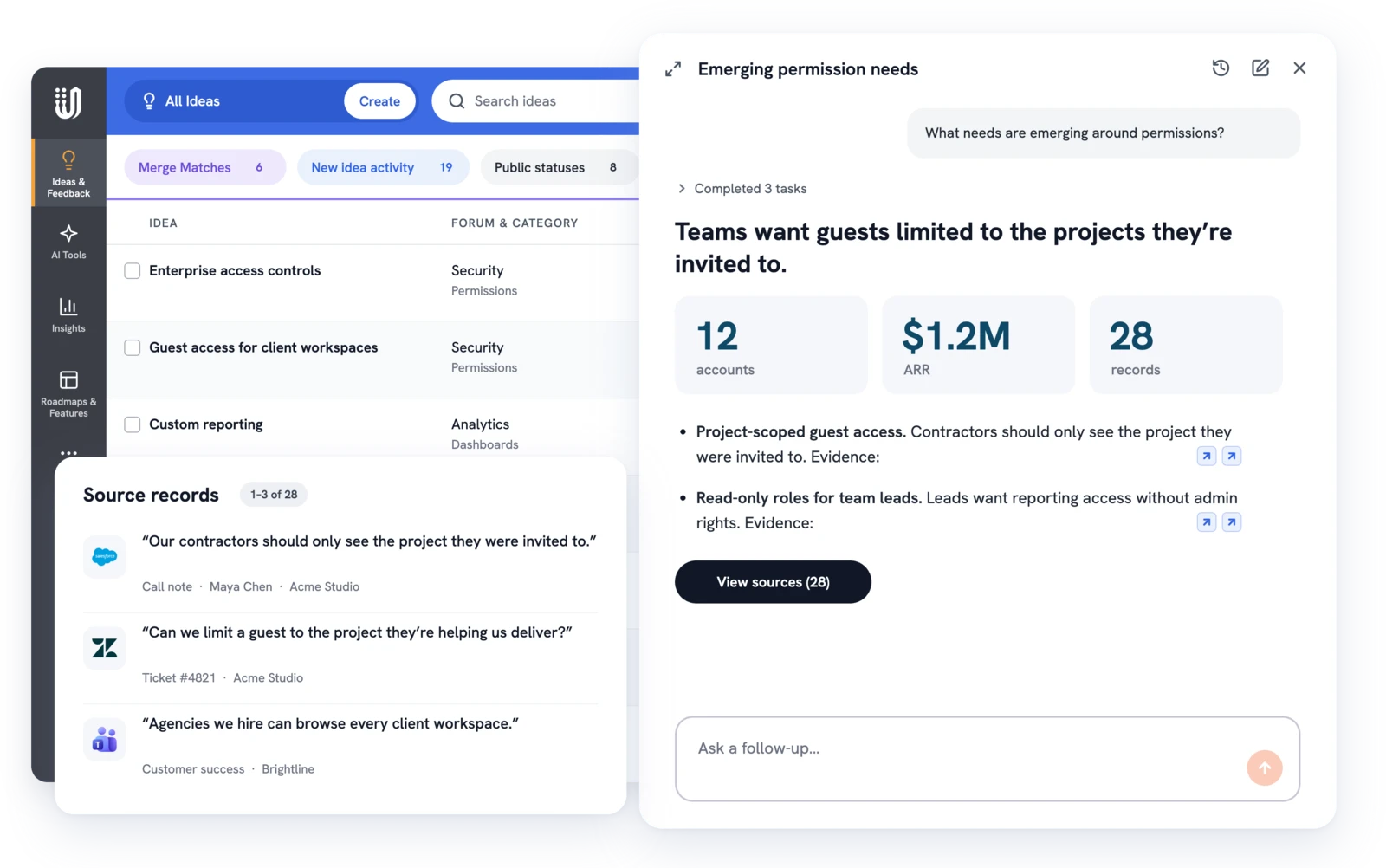
  • Every customer's words on the idea
  • Source links back to the conversation
  • Importance ratings from customers
  • Distinct supporting accounts and their revenue
  • Revenue visible only to people allowed to see it
Explore customer feedback scoring →
UserVoice agent summarizing an emerging customer need with 12 accounts, $1.2M ARR, and 28 records
Reach

Compare accounts and revenue, not just votes

An account counts once per idea, however many of its people vote. Sort the idea grid by accounts or revenue, or use Account Insights to plot every idea by both and filter to the customers your roadmap serves.
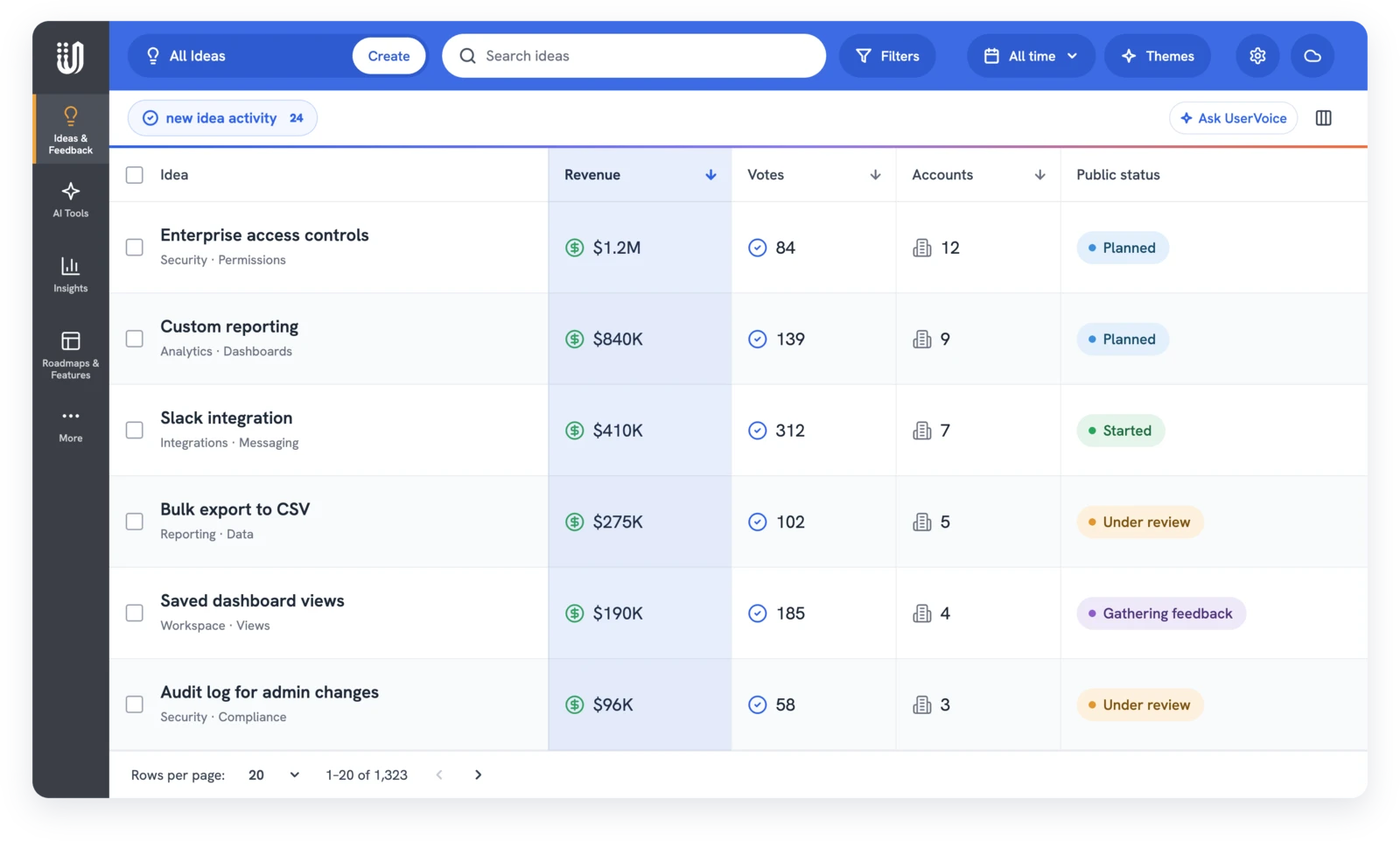
  • Sort ideas by votes, accounts, or revenue
  • Filter by account status, plan, segment, or industry
  • Save segments and compare their demand
  • Features count each account once across their linked ideas
Explore Account Insights →
UserVoice idea grid with the Revenue column highlighted next to votes and accounts
Plan and ship

Explain the choice, then show what shipped

Group ideas into features on an internal roadmap, and each card shows the revenue, accounts, and users behind it. Link ideas to the Jira issue or Azure DevOps work item, and the idea shows the issue's current status.
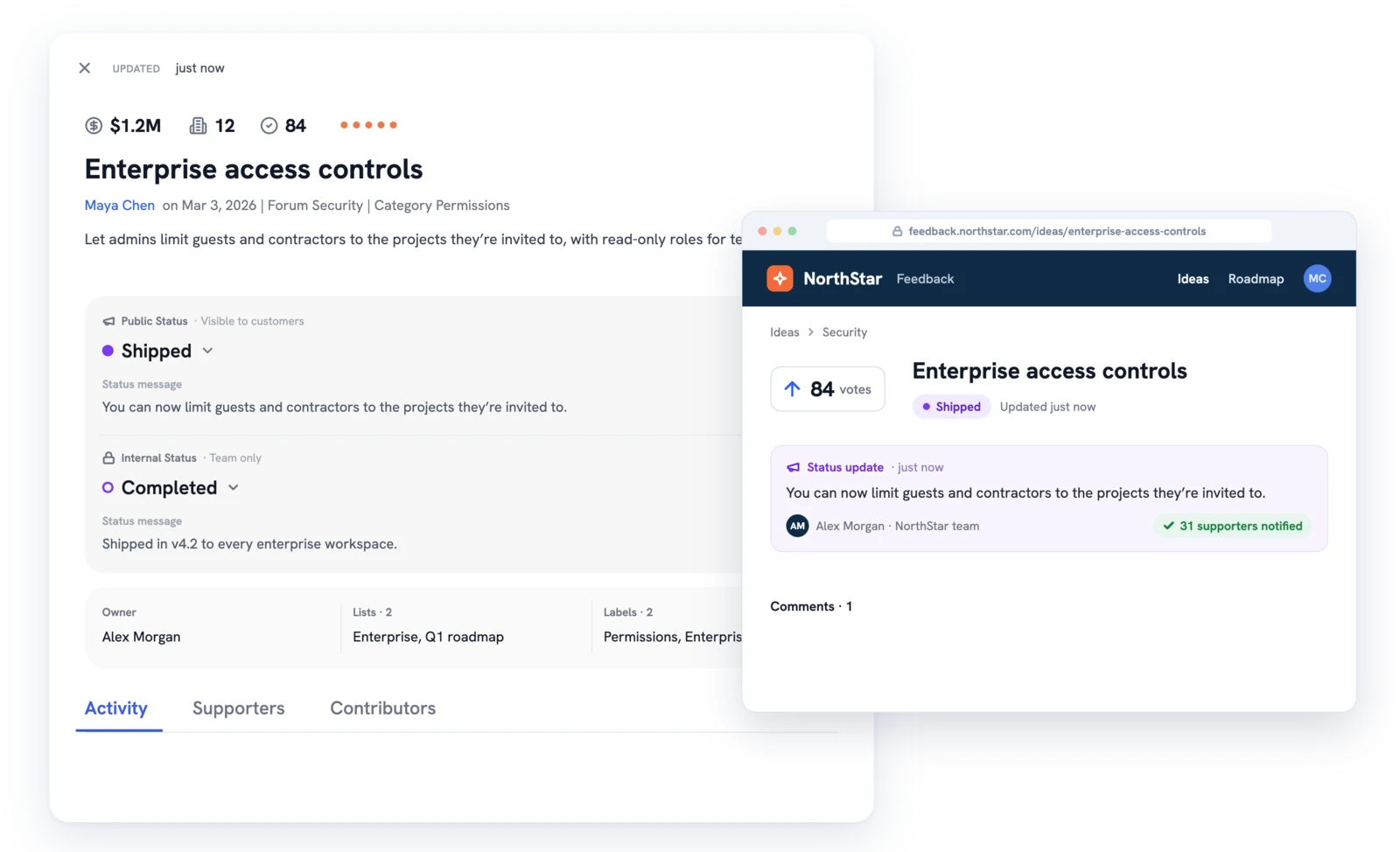
  • Share the roadmap and choose whether revenue and accounts show
  • Share with contributors, email domains, or publicly
  • Link existing issues or create new ones from the idea
  • Tell customers when the work ships
Explore customer communication →
UserVoice idea marked Shipped with its public status message and internal status
Know the limits

Evidence for the business case, not an ROI calculator

Combine the customer evidence with effort and results from your own analytics.

No ROI math
UserVoice has no cost or adoption data.
Revenue isn't at risk
It's current account revenue, not revenue won or saved.
Accounts count once
Features, labels, and lists dedupe; hand sums don't.
Measure results elsewhere
Use your analytics and CRM after release.
By role

Roadmap ROI evidence for every team that funds or sells it

The business case is built by product and read by everyone who funds or sells the roadmap.

Product leaders
Leaders bring ranked ideas to planning with the accounts and revenue attached. See customer feedback for product leaders.
Product managers
PMs compare ideas by reach, read the feedback, and link the winners to engineering work. Product teams can prioritize by revenue.
Executive teams
Executive teams review the roadmap with customer evidence on every card. See reporting to leadership.
Revenue leaders
Revenue teams see which roadmap items carry the most account revenue, synced from HubSpot or Salesforce.
Customer success
CSMs see what shipped for their accounts and share it at the next review. See customer success.
Engineering
Engineers see the customers behind the issue they're building, through the link from the idea. See linking to Jira and Azure DevOps.
Customers

Teams that show customers they were heard

UserVoice helps us turn customer feedback into shared intelligence across the business. As more teams engage, we get stronger insights, better analytics, and real momentum toward embedding the customer voice into our decision-making.

Ariana Newton, Product Operations Manager at Optimizely

Ariana Newton

Product Operations Manager @ Optimizely
We can quickly surface a complete, data-backed view of every client interaction (questions, feedback, and responses) and turn that into clear insights for renewals. It shows customers we’re listening and acting on what they tell us.

Kathryn Doebler, Director of Product Operations at Freewheel

Kathryn Doebler

Director of Product Operations @ Freewheel
There are a lot of problems to solve out there, and spending time on something that isn’t the most impactful for our users is heartbreaking. UserVoice challenges me to look at the overall picture of the struggles that our customers as a whole.

Megan Fangmeyer, Product Manager at Facts

Megan Fangmeyer

Product Manager @ Facts
AI and MCP

Prepare a roadmap ROI review in one message

The UserVoice agent and the UserVoice MCP server rank ideas, list supporting accounts, and find what shipped. Both follow each admin's permissions.

Compare two ideas
See who supports each, and who supports both.
Compare offline mode and bulk edit by accounts and revenue. Flag accounts that support both.
What shipped
Find the customers behind this quarter's work. See the MCP playbook.
Which ideas did we complete this quarter, and which accounts supported them?
What's waiting
Spot valuable requests that have waited longest.
Which open ideas with the most revenue behind them have been open longest?

Proving roadmap ROI: your questions, answered

Does UserVoice calculate roadmap ROI?

No. It has no cost or adoption data. It gives you the customer evidence: who asked, how many accounts, how much revenue, and what you told them.

Can I call all supporting revenue at risk?

No. It's the current revenue of accounts that support an idea, as your CRM stores it. It isn't revenue the work will win or save.

What if one account supports several ideas?

Inside a feature, label, or idea list, UserVoice counts that account once. If you add up idea totals by hand, you'll count it more than once.

Where does revenue come from?

From the field you map in Salesforce or HubSpot, such as ARR or MRR. UserVoice doesn't convert currency or period.

Can we share the evidence outside the product team?

Yes. Share the internal roadmap with contributors, specific email domains, or publicly, and choose whether accounts, users, and revenue show on the cards.

How do we measure results after release?

Use your product analytics and CRM for adoption and revenue. UserVoice records what shipped, who was told, and the accounts it reached.

Keep exploring

Go deeper where it matters

Show the evidence behind your roadmap

Get a free 30-day trial after your demo, see your own customer feedback in a real account.

Book a demo