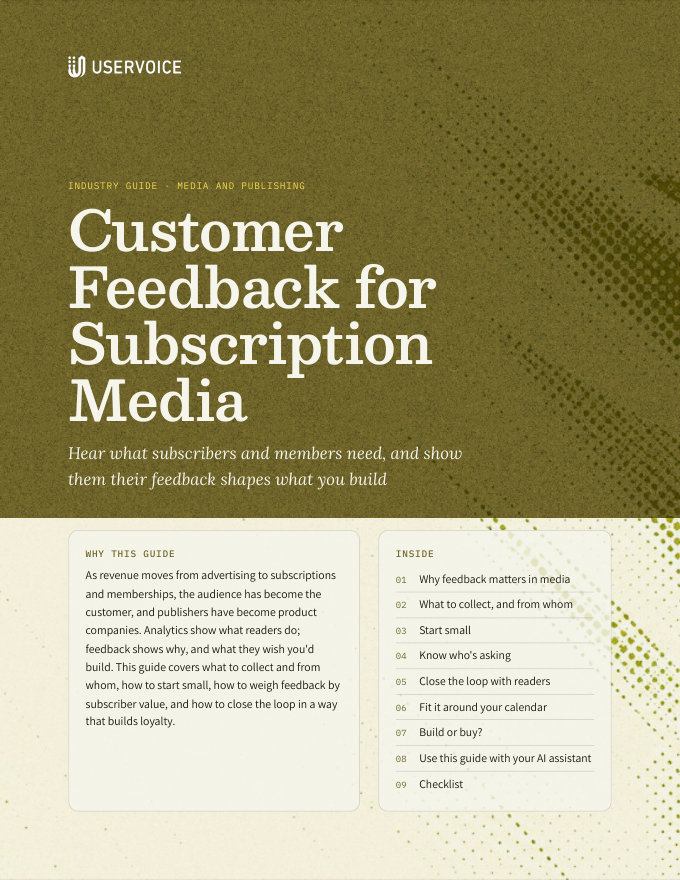
Customer Feedback for Subscription Media
Hear what subscribers and members need, and show them their feedback shapes what you build.
On this page
As revenue moves from advertising to subscriptions and memberships, the audience has become the customer, and publishers have become product companies. Analytics show what readers do; feedback shows why, and what they wish you'd build. This guide covers what to collect and from whom, how to start small, how to weigh feedback by subscriber value, and how to close the loop in a way that builds loyalty.
Why feedback matters in media
Publishers now run apps, paywalls, newsletters, and membership programs, with roadmaps to match. Few have a way to hear what subscribers want from them.
Your analytics tools show what readers did. Feedback shows why, and what they couldn't do.
A subscriber who sees their idea shipped has a reason to renew.
Newsrooms promise to hear their audience. Closing the loop on product feedback proves it.
Institutional and professional subscribers renew annually, at prices where each account's needs matter.
What to collect, and from whom
Most publishers hear from three groups. Give each a place that fits.
| Audience | What they tell you about | Where it goes |
|---|---|---|
| Subscribers and members | Your apps, website, newsletters, account and billing pages, and podcasts | A portal, public or private, with forums by product |
| Institutional and professional subscribers | Features their organization needs, such as data access, licensing, and team accounts | A private forum, with accounts and revenue from your CRM |
| Your newsroom and staff | Your CMS, publishing tools, and internal workflows | An internal program your teams capture into |
Start small
The first worry is usually not the software. It's whether your team can keep up once readers start posting. Start where you can respond.
- Open a private, invitation-only forum for a few hundred engaged members or subscribers.
- Agree on a review rhythm you can keep, such as every two weeks, and say it in the welcome message.
- Post a few status updates in the first month, so early participants see results.
- Add your newsroom and customer-facing teams as contributors.
- Open the portal more widely once the rhythm holds.
Know who's asking
A request from a ten-year member and one from a free reader aren't the same signal. Bring subscriber details into UserVoice so you can tell them apart.
| Detail | How it gets into UserVoice | What it lets you do |
|---|---|---|
| Subscription tier or membership level | Imported as user fields, or sent through the API | Compare what paying members want with everyone else |
| Tenure or start date | User fields, from your subscription platform | Weigh long-time subscribers' requests |
| Institutional accounts and revenue | Salesforce or HubSpot sync | Sort professional subscribers' requests by revenue |
| Churn or donor status | User fields, from your subscription or member CRM | Spot what lapsed members asked for |
Subscription platforms connect through the API. Paywall, membership, and billing platforms such as Piano, Memberful, Zuora, and Stripe can send subscriber details to UserVoice through its API.
Close the loop with readers
“You asked, we built it” is a loyalty story your audience understands immediately. Tell it every time.
- Post status updates with a message. Everyone who voted or posted gets the email.
- Feature reader ideas in your newsletter or member updates, with a link to the idea.
- Credit the community in release notes for app and site changes.
- Explain a “not now”. Readers accept a reason. They don't accept silence.
Status update: Completed
Fit it around your calendar
Launches, elections, pledge drives, and breaking news set your schedule. Plan feedback around them, not against them.
| When | What to do |
|---|---|
| Before a launch | Invite members to test it in a private forum, and collect feedback there. |
| Launch week | Mark the related ideas Completed, and thank the members who asked. |
| During a big news cycle | Keep the review rhythm, but say in the welcome message that responses may be slower. |
| Membership and renewal campaigns | Highlight what members asked for and you delivered this year. |
| Quarterly | Review top requests by subscriber tier with product and audience teams. |
Build or buy?
Publishers with engineering teams often ask whether to build this themselves. Ask what you'd be signing up to maintain.
| You'd need to build | Why it's harder than it looks |
|---|---|
| A portal and voting | Spam, moderation, sign-in, and accessibility, maintained for years |
| Duplicate detection | Readers describe the same need a hundred ways |
| Subscriber and account context | Syncing tiers, tenure, and institutional revenue from several systems |
| Status emails to everyone who asked | Subscriptions, preferences, and deliverability |
| Capture for your staff | Browser and Slack tools, so feedback from support and sales isn't lost |
Try it with your AI assistant
1 of 4 prompts in the PDFAttach the PDF to Claude, ChatGPT, or another assistant, then paste:
Using the guide I attached, help me plan a feedback program for [publication]. Ask me about our products, subscribers, and newsroom first.
Three more prompts and the checklist are in the full guide. Get it by email →
Read next
Get the full guide
We'll email you the 10-page PDF. It adds two things that aren't on this page:
- A six-step checklist to put the guide into practice
- Four AI prompts for Claude, ChatGPT, or your assistant of choice, including one that uses the UserVoice MCP to work with your own feedback data