

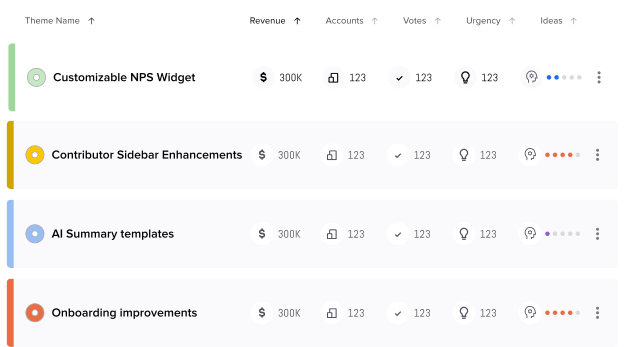
Automatically surface the ideas with the highest impact across revenue, retention, and customer demand.
Balance qualitative feedback with quantitative signals to focus on what will move the needle.
Make roadmap decisions based on evidence, not anecdotes.
Automatically summarize and surface the most important ideas across all feedback. Organizing them in the first place is idea management.
UserVoice helps rank ideas by real customer impact, revenue, demand, and more. Day to day, that work is feature request management.
Detect emerging patterns and recurring themes across customer submissions.
Analyze feedback by customer type, plan, or account to understand demand.
Attach user, account, and revenue data to every idea automatically.
Capture feedback from your portal, widget, Slack and customer-facing teams in one centralized system. The broader category this sits within is product feedback software.
Get a free 30-day trial after your demo, see your own customer feedback in a real account.
Book a demo
UserVoice replaces simple vote counting with revenue-weighted prioritization, linking each request to CRM data so decisions reflect actual business impact rather than which customers submit the most tickets.
UserVoice brings together feedback from your portal, in-app widget, feedback extension and Slack, plus CSV imports.
Yes. UserVoice surfaces which customer problems appear most frequently in at-risk accounts and which unmet needs represent the largest expansion opportunities, connecting feedback directly to revenue outcomes.
UserVoice is built for cross-functional use: product teams use it for roadmap prioritization, CS teams use it to close the loop with customers, and revenue leaders use it to bring customer evidence into forecast and board conversations.
UserVoice ranks feedback using a combination of signals, including revenue, account size, retention risk, and demand frequency, all pulled from connected CRM and support data rather than relying on manual scoring or vote totals.
Vote counts reward the loudest customers; revenue-weighted prioritization reflects the accounts and dollars actually behind each request, so teams build what protects retention and drives expansion, not just what gets the most clicks.


