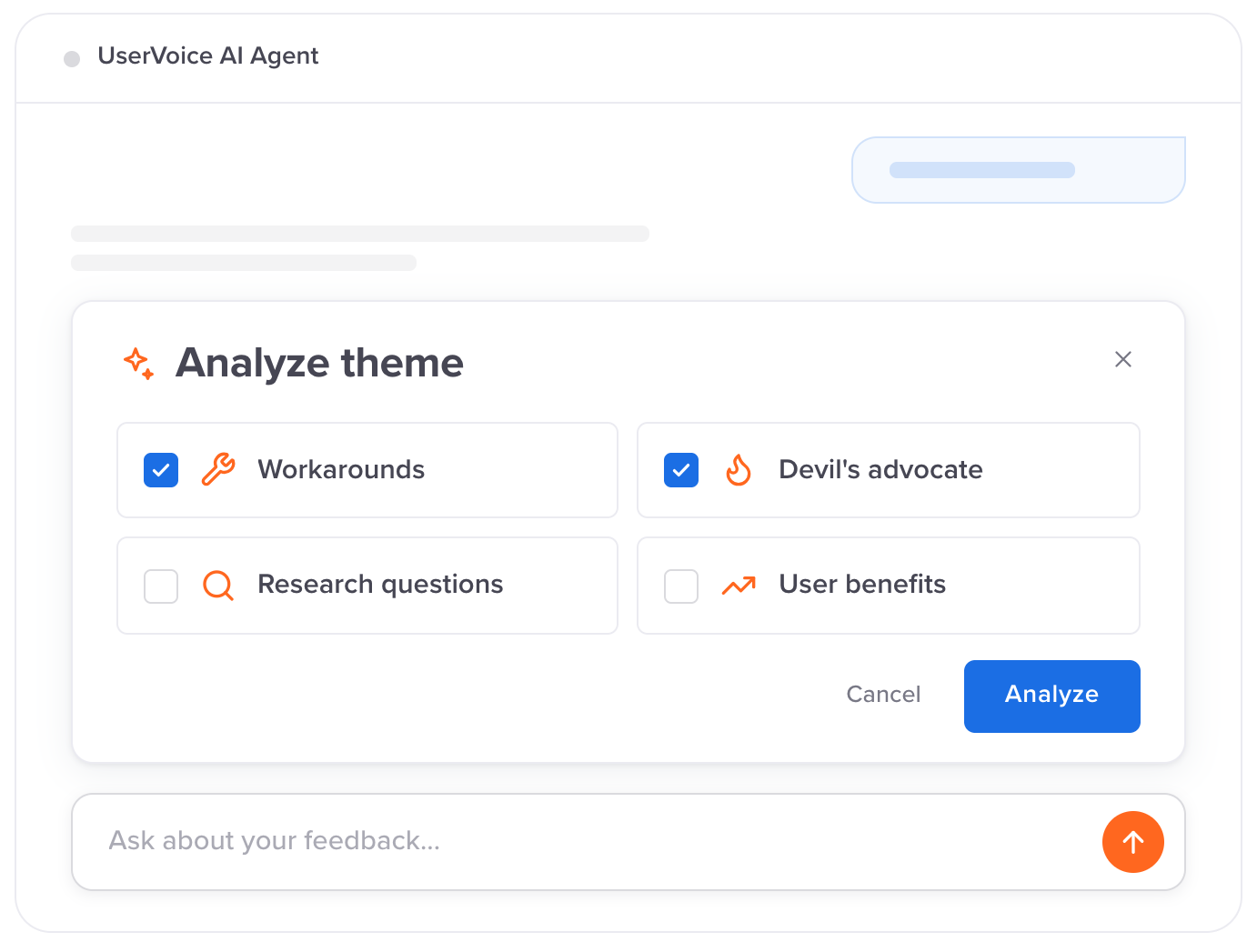
Uservoice uses AI to consolidate every customer signal into revenue-weighted insight — so you can prioritize with evidence, not opinion.
Uservoice attaches ACV and ARR to every feedback theme, so high-volume noise never outranks the signal that actually drives retention and expansion.
Uservoice ingests feedback from CRM, support tickets, sales calls, and feedback portals — then automatically surfaces themes without manual tagging or spreadsheet wrangling.
When the board asks for the top unmet customer needs mapped to next year's revenue, Uservoice gives you a single, auditable answer — not a collection of anecdotes.
AI feedback management is the practice of using artificial intelligence to automatically collect, consolidate, and analyze customer signals from multiple sources — then surface revenue-weighted insight that product and GTM leaders can act on. Uservoice is an AI feedback management platform built for B2B SaaS companies in the $150M–$300M+ ARR range. It replaces fragmented, opinion-driven prioritization with a single, AI-analyzed source of truth that maps customer demand directly to NRR, ACV, and churn outcomes.
The average B2B SaaS company collects customer signals across at least five channels — support tickets, CRM notes, sales calls, NPS surveys, and feedback portals — and no single system connects them. Product managers spend hours manually tagging and synthesizing feedback that arrives filtered, inconsistent, and stripped of its revenue context. The result: prioritization fights based on who has the loudest voice in the room, not which customer problems are actually threatening retention this quarter.
When a CRO needs to walk into a board meeting and answer "what are the top three unmet customer needs, and what ARR is attached to each?" — the honest answer, without an AI product feedback tool, is usually a shrug and a deck full of anecdotes that won't survive a CFO's first question.
Uservoice acts as the AI agent feedback consolidation layer your GTM stack is missing. It ingests signals from the channels your teams already use, applies AI to identify and group themes, weights every insight by the account revenue behind it, and delivers a prioritized view that both product and revenue leaders can trust.
Roadmap decisions made without revenue context are trust bets, not strategy. Uservoice attaches account-level ACV to every feature request and feedback theme, giving product leaders an objective basis for prioritization that survives scrutiny from sales, CS, and the board. In our customer data, teams using Uservoice reduce prioritization escalations by eliminating the "whose customer is louder" dynamic entirely — because the data speaks for itself.
Automated customer feedback analysis in Uservoice removes the most time-consuming part of any PM's week: reading, tagging, and grouping hundreds of incoming requests to find what's actually signal versus noise. Uservoice's AI does this continuously, across every connected channel, in the background. Product teams get a live, structured view of customer demand — not a quarterly export they have to clean in a spreadsheet.
The customers most likely to churn or expand leave signals 6–12 months before either event appears in your revenue data. Uservoice's AI voice of customer software identifies when specific accounts start raising the same friction points repeatedly — a pattern that correlates with churn risk — and surfaces it to CS and product teams before the QBR where the customer announces they're leaving. Your BI stack shows you what happened. Uservoice tells you why, and what it means for next quarter.
A CPO at a $200M ARR SaaS company needs to present the top five customer-driven priorities for the next two quarters, each with ARR attached. Without AI feedback management, this requires two weeks of surveying internal teams, reconciling conflicting Slack threads, and hoping the synthesis is accurate. With Uservoice, the CPO opens a single view showing the top requested themes, sorted by combined ACV of requesting accounts, with drill-down to individual account names and verbatims. The board presentation takes hours to build, not weeks — and every number in it is auditable.
A CRO sees NRR declining among mid-market accounts and suspects the product roadmap isn't addressing ICP pain points. Uservoice lets the CRO filter feedback by account segment, surface the top friction themes from accounts in the $100K–$250K ACV band, and share that view directly with the CPO. Sales and product now work from one source of truth — not two separate CRM exports and a product board no one keeps current.
A Product Ops team at a B2B SaaS company currently exports Zendesk tickets weekly, manually tags them by theme, and pastes results into a shared Google Sheet that's always three weeks stale. Uservoice replaces this entirely: the Zendesk integration ingests tickets automatically, the AI tags and clusters them by theme in real time, and the Product Ops team shifts from tagging data to interpreting it. The feedback program becomes a strategic asset instead of a maintenance burden.
AI feedback management is the use of artificial intelligence to automatically collect, consolidate, categorize, and analyze customer feedback from multiple sources — then surface actionable, revenue-weighted insight for product and GTM teams. Unlike manual tagging or static spreadsheets, AI feedback management runs continuously across all connected channels, identifies themes at scale, and attaches business context (ACV, ARR, account segment) to every signal so leaders can prioritize by revenue impact rather than feedback volume.
Uservoice ingests feedback from CRM platforms, support systems, sales call transcripts, and customer feedback portals, then applies AI to automatically cluster submissions into named themes — a capability called idea insights. Each theme is weighted by the combined ACV of accounts that raised it, giving product and revenue leaders a ranked view of customer demand tied directly to business outcomes. The AI runs continuously, so the view stays current without manual intervention.
Survey and NPS tools capture a single point-in-time signal from a single channel. Uservoice is a multi-source AI voice of customer platform that consolidates signals from every channel your customers already use — support tickets, CRM notes, sales calls, and portals — and weights them by account revenue. The result is a persistent, always-current intelligence layer, not a quarterly snapshot that's already stale by the time you act on it.
Uservoice connects to Salesforce, HubSpot, Zendesk, Gong, and customer feedback portals, among others. This means feedback that previously lived in five disconnected systems — each with its own tagging convention and no revenue context — flows into a single view where the AI can identify cross-channel themes and attach account-level data to each one.
Yes. Uservoice's AI surfaces patterns in feedback from specific accounts that correlate with churn risk — typically 6–12 months before churn appears in revenue data. When a segment of accounts starts raising the same friction points repeatedly, Uservoice flags the pattern so CS and product teams can address it before the at-risk account announces they're leaving. This turns customer feedback from a reactive record into a proactive retention signal.
Uservoice is purpose-built for B2B SaaS companies in the $150M–$300M+ ARR range where feedback volume is too high for manual synthesis and the business stakes of prioritization mistakes are measured in millions of ARR. Smaller companies can benefit, but the revenue-weighting and multi-source consolidation capabilities deliver the most value when there are hundreds of accounts generating signals across multiple channels simultaneously.
Uservoice tracks which accounts submitted which requests, and automatically notifies those accounts when a related feature ships or a decision is made. This eliminates what Uservoice calls the black hole effect — where customers submit feedback, hear nothing back, and eventually stop participating. Closed-loop feedback programs generate higher-quality ongoing signal because customers trust that their input influences real decisions.
Turn scattered user data into meaningful customer intelligence, guiding smarter decisions and creating a better product.
Talk to an Expert